Drum beats for beginners
 Ross Farley is a drummer, drum teacher and the maker of Beam.
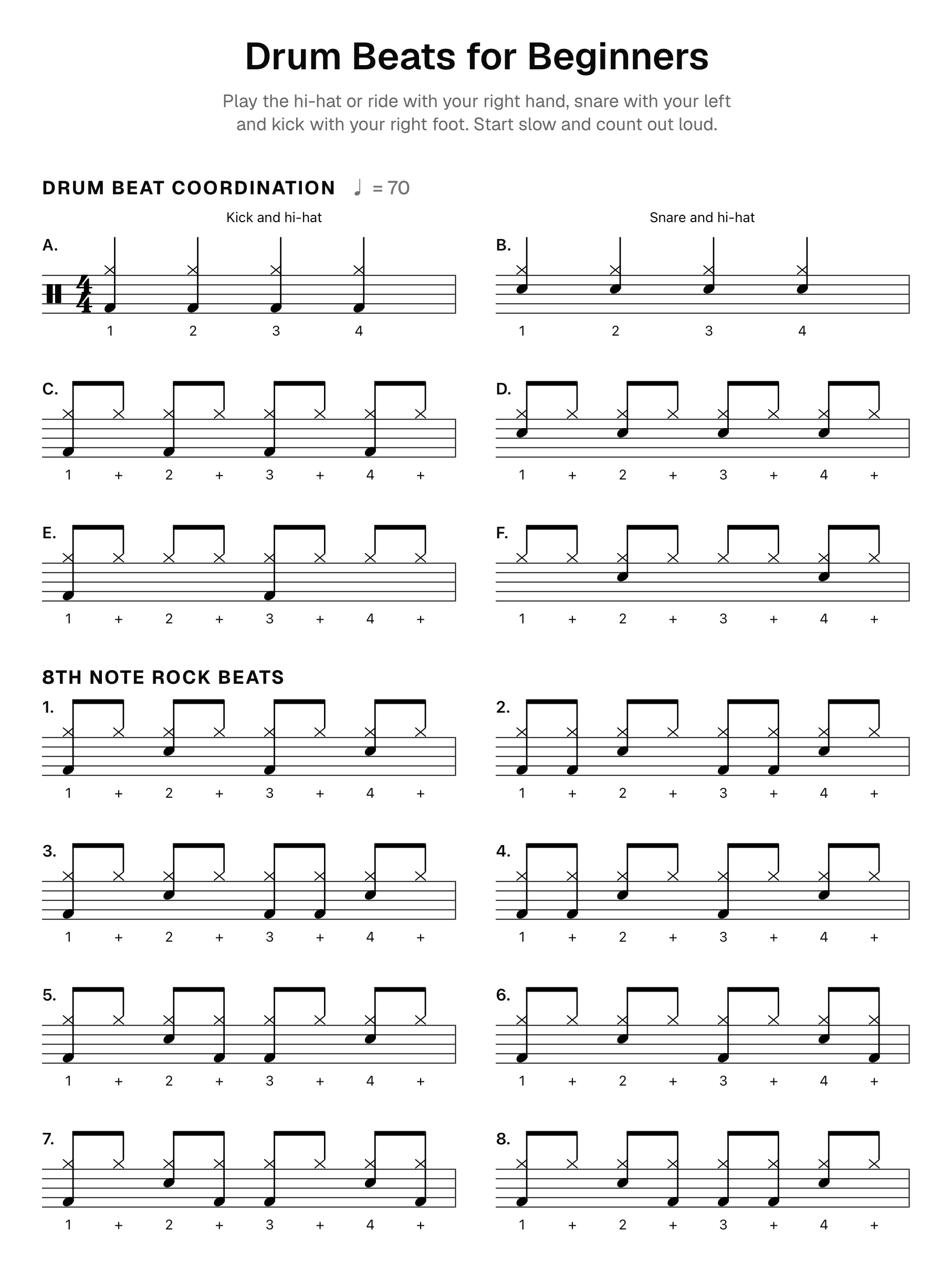
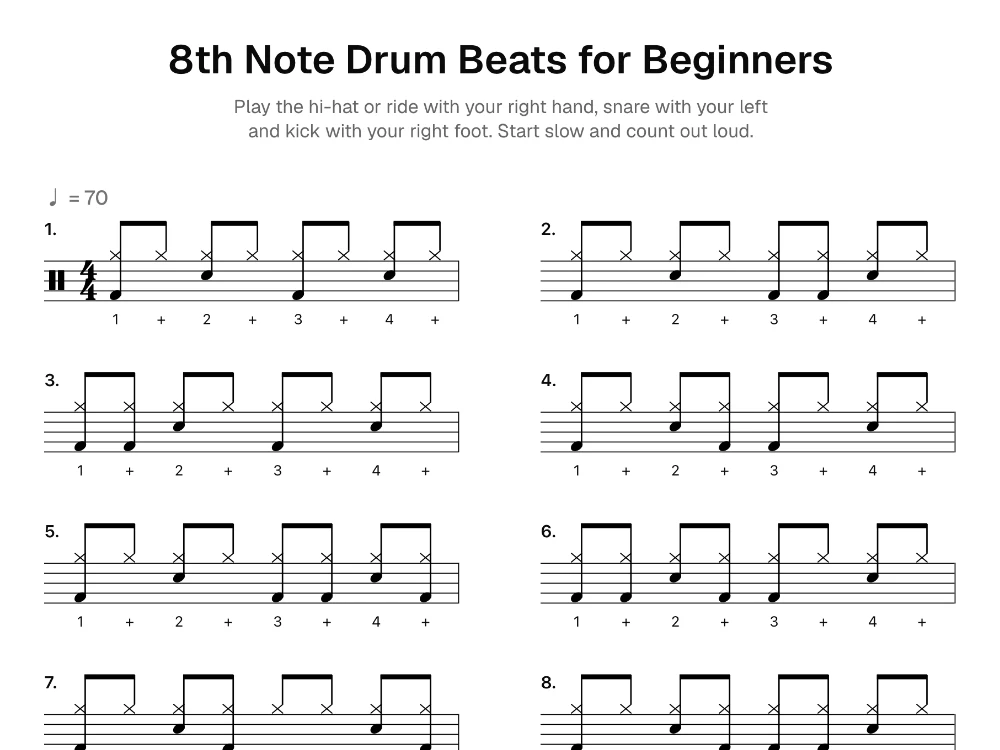
Learn to play your first drum beats. There are six exercises to get your hands and feet working together, then there are eight common 8th note rock beats to practise.
Before you start
First up, how to practise these exercises. Start slow and count out loud (this is a great skill to develop). Practise each exercise until it feels easy, then move on. When you can play them on the hi-hat, play them all again on the ride cymbal.
Your right hand will play the cymbal part (hi-hat or ride) and your left hand will play the snare. Your right foot is going to play the kick. If you’re playing a left-handed setup, reverse the stickings.
Here is how you read the notation in these exercises:
For a full drum legend, see How to write drum notation.
Drum beat coordination
Exercises A and B
Quarter notes first. Your right hand plays the hi-hat on every beat, with the kick in exercise A and with the snare in B. Make sure the two notes land exactly together.
Exercises C and D
Now the hi-hat plays 8th notes: 1 + 2 + 3 + 4 +. The kick or the snare plays on every beat. As you count, emphasise where the snares or kicks fall.
Exercises E and F
Exercise E features a kick on beats 1 and 3. F features a snare on beats 2 and 4, known as the backbeat.
Pairing them up
Once you can play them all easily, pair them up in any combination: a bar of one, then a bar of another. Alternate back and forth until you can do it consistently.
8th note rock beats
The following exercises are common drum beats in rock and pop styles. The hi-hat and the snare stay the same in each exercise. The kick pattern changes.
Just like with the coordination exercises, try pairing up the drum beats for an extra challenge.
Keep practising in Beam
Open the worksheet in Beam to loop any exercise and slow it down. Sign up free to save your own copy.
Practise in BeamTeaching?
I made this worksheet in Beam, and you can make your own for your students.